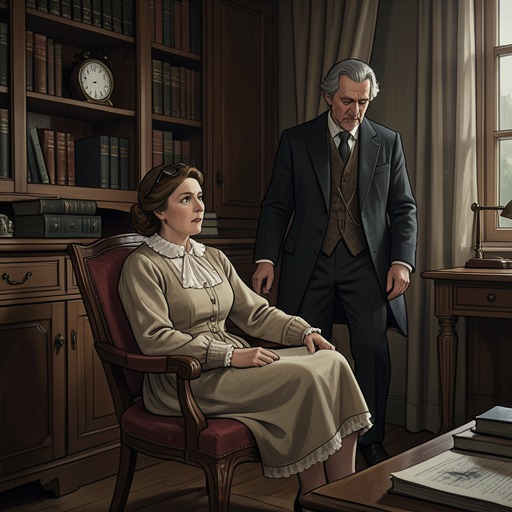
Clare’s List
The Time Traveler's WifeClare’s List is a pale-blue child’s diary that records 152 dates when Henry visited Clare. More than a keepsake, it functions as a working calendar for their meetings: Henry tells Clare when to go to the Meadow, while the dates she records later give Henry a guide to encounters he has already experienced. Its circular origin makes the diary a small, concrete form of the novel’s temporal logic, in which memory and anticipation repeatedly supply one another with evidence.
The diary and its dates
On their first date, October 26, 1991, Clare gives Henry the diary. Its pages are marked by cocker spaniel puppies, and a scrap of newspaper marks the place she has opened. The list begins on September 23, 1977, and ends on May 24, 1989; across sixteen small pages, Clare has recorded 152 dates in the careful handwriting of a six-year-old, using a large blue ballpoint pen. The object is at once a child’s record and a surprisingly exact archive of visits spanning years of her life.
The diary does not begin as Clare’s independent record of events. She explains that Henry dictated the dates to her. At their 1991 meeting, Henry recognizes the list and says that he memorized its dates; he used them to know when to go down to the Meadow to meet her. The information runs in both directions: the adult Henry’s memory shapes what the child Clare writes, and the resulting pages later help guide Henry’s own movements. The book makes the record’s puzzling circularity tangible without resolving it into a simple first cause.
A schedule for meeting
The List’s function is especially clear when Henry consults it from memory to tell young Clare when he will return. He specifies October 16, identifies it as a Friday, and tells her to come to the Meadow after school. He also instructs her to bring the little blue diary Megan gave her for her birthday and a blue ballpoint pen. The date is therefore not merely retrospective evidence: it is part of the mechanism by which the next record and meeting can occur.
The Meadow is on Clare’s parents’ property in Michigan. Clare describes a clearing roughly ten feet across, with a large rock at its center, concealed from the house by the rise and dip of the land. She used to play there alone, believing no one knew about the place, until Henry appeared when she was in first grade. The List’s dates connect this private meeting place to a sequence Clare can preserve and Henry can navigate. Its precision—day, weekday, and instruction—turns an otherwise extraordinary relationship into a repeated appointment.
Circular knowledge and limits
When Henry and Clare discuss whether the future can be changed, Clare points to the List as evidence that he does change things: without it, she says, she would not know when to meet him. Henry answers that he can only do things that work toward what has already happened. The exchange distinguishes the List’s practical power from freedom to alter the events it records. It enables action, but within a pattern whose outcomes are already part of their shared history.
That constraint gives the diary its distinctive paradox. It appears to document past meetings, yet its dates also direct future meetings; the adult Henry recalls information that the child Clare will write down, and the written record later returns to him as a guide. The List is thus both an intimate gift and an instrument of temporal continuity. Its blue pages hold the history of Henry’s visits, but they also help produce the occasions that make that history possible.